
Many organizations now claim to care about deep tech. They reference AI in strategic decks, attend ecosystem events, and run occasional pilots. But far fewer have built the institutional machinery required to identify, evaluate, fund, pilot, deploy, and learn from frontier technologies in a repeatable way.
That gap matters. In deep tech, the difference between interest and readiness determines whether promising technologies become operational capability, whether pilots convert into scaled deployments, and whether organizations can absorb long-horizon technologies without reducing them to short-term theater.
The core logic behind the Deep Tech Maturity Index (DTMI) is simple: maturity should be assessed through structures, behaviors, and operating mechanisms, not narrative alone.
What the Index Measures
The DTMI measures whether an organization has the strategic alignment, institutional capacity, and execution pathways required to engage meaningfully with frontier technologies: AI, advanced materials, biotechnology, quantum, space, and energy transition.
It is not trying to capture generic innovativeness. It asks a more demanding question: Is deep tech embedded in the organization in a way that can survive procurement friction, budget constraints, capability gaps, and long deployment cycles?
Many organizations overestimate their maturity because they confuse visible activity with actual preparedness. A company may signal ambition publicly yet lack an executive sponsor, a dedicated budget, internal capability to evaluate technical opportunities, and a procurement pathway for non-traditional suppliers. Another may run several pilots yet lack any mechanism to scale them. The DTMI surfaces these differences.
Why the Model Works at Two Levels
The model operates intentionally on two levels.
At the first level, it gives leadership teams a maturity band: Emerging, Developing, Capable, Advanced, or Leading. The band is the headline interpretation. It gives executives a fast read on whether deep tech is still an ad hoc activity, becoming structured, repeatable in parts of the organization, advanced across several areas, or institutionalized as a source of strategic advantage.

At the second level, it breaks readiness into seven diagnostic dimensions:
- Engagement Mode
- Strategy & Governance
- Investment & Resources
- Execution Competencies
- Operational Execution
- Ecosystem & Partnerships
- Risk & Ambition.
This layer provides analytical resolution, identifying where strength is concentrated, where bottlenecks sit, and where organizations that look similar at high level are structurally different.
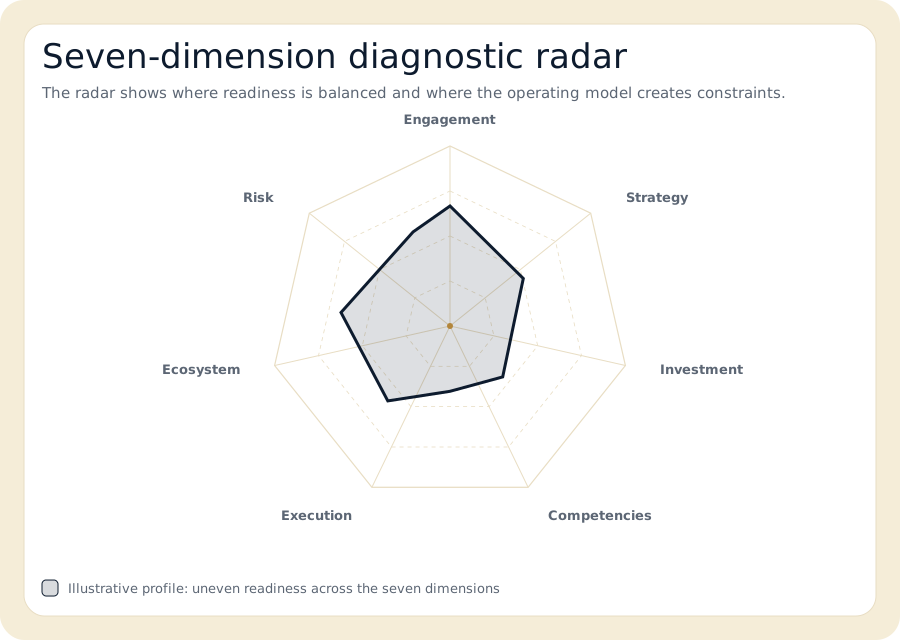
The model also includes an engagement-mode profile, showing how the organization works with the deep tech ecosystem across technology integration, open innovation or venture clienting, corporate venture or investment, R&D co-development, and public or consortium programs. This profile helps explain the diagnostic result: two organizations may have the same maturity band while engaging with the ecosystem in very different ways.
Deep tech readiness is rarely distributed evenly. An organization may have strong strategic language but weak execution pathways. It may have ecosystem access but lack internal absorptive capacity. It may have budget but no fast-track process for pilots. The seven-dimensional structure prevents these different realities from collapsing into vague maturity talk.
The Seven Dimensions
Each dimension captures a distinct aspect of deep tech readiness:
- Engagement Mode captures the depth of involvement across technology integration, venture clienting, corporate venture, R&D co-development, and public or consortium programs. Strength means the organization knows which collaboration modes fit its strategy. Weakness means activity is scattered or observational.
- Strategy & Governance captures whether deep tech has moved from aspiration to institutional commitment: strategic inclusion, executive sponsorship, and problem-statement discipline before solution scouting. Strength shows up as board-level ownership and clear mandates. Weaknesses show up as vague references, fragmented ownership, and opportunistic solution hunting.
- Investment & Resources assesses the seriousness of capital allocation, dedicated budget lines, and diversified financing mechanisms. Strength means explicit allocation and flexible funding structures. Weakness means absent or opportunistic resourcing.
- Execution Competencies measures internal ability to define needs, evaluate technical opportunities, manage initiatives, and capture learning. Strength means internal absorptive capacity. Weakness means dependence on external consultants and ad hoc exposure.
- Operational Execution captures movement from interest to execution: pilot volume, conversion rates, procurement adaptability, time-to-launch, and TRL practice. Strength shows up as meaningful conversion to scale and innovation-adapted procurement. Weaknesses show up as pilot theater, slow launches, rigid processes, and projects trapped in internal testing.
- Ecosystem & Partnerships measures the breadth of external engagement: startups, universities, consortia, public programs, and industry alliances. Ecosystem access only creates value when internal mechanisms exist to act on discoveries. Strength means diversified collaboration. Weakness means shallow engagement limited to occasional startup exposure.
- Risk & Ambition captures appetite for cross-border and pre-commercial engagement, learning capture from pilots, and orientation toward frontier-scale solutions. Strength shows up as structured risk tolerance and codified learning. Weakness shows up as risk aversion disguised as process, repeated pilot failure patterns, and ambition that does not survive procurement friction.
What the Index Is Not For
The DTMI is a diagnostic and benchmarking tool, not a prestige mechanism. It is not designed to rank companies publicly, measure generic innovativeness, reward buzzword adoption, or directly assess the scientific quality of R&D. It does not predict financial performance and should never substitute for deep due diligence.
A low or uneven score is not a moral judgment. Often, it is the beginning of a more useful conversation. The model helps avoid confusing ambition with readiness, pilot activity with deployment capability, ecosystem visibility with internal absorptive capacity, and innovation rhetoric with institutional commitment.
Why This Matters
For corporates, the DTMI provides a structured way to benchmark readiness, identify internal bottlenecks, and understand why deep tech efforts stall even when executive interest exists. It can inform capability-building, workshop design, internal alignment discussions, and prioritization decisions.
For startups and technology suppliers, the index improves the quality of counterparties. When corporates cannot procure fast enough, lack internal sponsors, or run pilots without scale pathways, startup engagement becomes expensive theater. Better diagnostics improve matchmaking.
For investors, venture client teams, and ecosystem builders, the index offers a way to see beyond superficial corporate innovation signaling. That matters especially where commercialization gaps, long procurement cycles, and weak pilot-to-contract conversion undermine technically strong sectors.
For public-sector innovation actors, the index can distinguish between organizations merely adjacent to frontier technology discourse and those capable of acting as serious adoption partners.
Conclusion
Deep tech maturity should not be inferred from interest, language, or isolated activity. It should be assessed through the structures that determine whether frontier technologies can actually be identified, absorbed, funded, piloted, deployed, and learned from over time.
That is what the DTMI is designed to do. It does not ask whether an organization likes the idea of deep tech. It asks whether deep tech is strategically anchored, operationally supported, and executable in practice.